Contact North Carolina 811 at: 811 or 1-800-632-4949 before you dig to help reduce damages to underground facilities.
Mission Statement
To promote damage prevention and safe digging through communication of excavation activities and to educate facility operators, excavators and the general public.
Introduction
This manual is intended as a resource to aid in the prevention of damage to underground facility owners’ and operators’ facilities in the State of North Carolina. North Carolina 811 developed this guide to enhance public safety, to protect the environment, to minimize risks to excavators and to prevent disruption of vital public services.
Throughout this booklet all instances of the abbreviation: NC811 refers to North Carolina 811, Inc.
THE 811 LOGO IS A REGISTERED TRADEMARK OF COMMON GROUND ALLIANCE, USED WITH PERMISSION
This manual does not have a copyright. North Carolina 811 recommends duplication of any or all parts of this manual at no cost to the reader. Additional copies may be obtained free of charge through North Carolina 811, unless requesting copies for courses that charges a fee for their training. The contents of this manual are subject to change without notice.
*This edition was updated October 2026
This manual is an educational and informational document. It is to be used by parties excavating in North Carolina as a guide for contacting North Carolina 811, Inc. (NC811). The manual is not a supplement for requirements to the State Underground Utility Safety and Damage Prevention Act, OSHA standards nor any local ordinance. The manual does not relieve any excavator from his or her responsibilities as provided by the Underground Utility Safety and Damage Prevention Act. North Carolina 811 does not assume any responsibility for the acts or conduct of any reader of this manual.
NC811 has made every effort to produce this manual free from errors, but neither NC811 nor any of its officers, employees or agents make any representations or warranties as to the accuracy of the information contained herein. Likewise, this manual, includes a reproduction of the Underground Utility Safety and Damage Prevention Act, and is provided solely as a convenience and is not to be used as a legal reference document. Every effort has been made to reproduce the Underground Utility Safety and Damage Prevention Act accurately, but neither North Carolina 811, nor any officer, employee or agent of the above named entity, makes any representations or warranties as to the accuracy of the reproduction of the law.
Persons seeking a legal reference document should contact his or her legal representative.
Utility Location Toll Free within NC811 Toll Free outside NC800-632-4949
Positive Response - Online Only
Corporate Offices Local Telephone336-855-5760
Member Services Department Direct Line336-854-8597
Remote Ticket Entry Department Direct Line336-316-0359
Website: NC811.org
App: “North Carolina 811” (for Apple and Android devices)
Executive Director: Louis Panzer Operations Manager: Stephanie Brown Center Managers: Angela Ashburn, Tammy Hewitt Accounting Manager:Sonia Level Public Awareness & Outreach Manager:Ann Rushing Creative Media Specialist:Steven Moore Member Services ManagerLesley Brouillard Remote Ticket Entry Manager:Wendy Fisher IT Manager:Chris Creed
Monday – Friday 7:00 am to 6:00 pm open for all locate requests (excluding holidays)
Note: North Carolina 811 is a 24 hours a day, 7 day a week operation. Someone is always available to take an emergency locate request.
The following holidays are observed by North Carolina 811
New Year’s Day
Martin Luther King Jr. Day*
Good Friday
Memorial Day
Independence Day
Labor Day
Veterans Day*
Thanksgiving Day
Day After Thanksgiving*
Christmas Eve
Christmas Day
Day After Christmas*
*All excavation and demolition requests are accepted, but this day is NOT included in the 3 full working day notice.
Who We Are
North Carolina 811, Inc. (NC811) is a non-profit corporation in the State of North Carolina. The Corporation was formed in 1978 and is fully funded by participating member facility operators in North Carolina. North Carolina 811 was formed for the purpose of receiving notification from excavators of intended excavation in a specific area in the State.
What We Do
The excavation and demolition notifications received by NC811 are disseminated to North Carolina 811 members that have underground facilities in the specific area given on the notification.
NC811 maintains a database of the general area of underground facility information that has been provided by its member facility operators in order to provide those members with excavation notifications.
NC811 does NOT do any of the following:
Physically mark any underground facilities.
Settle disputes between excavators and members.
Keep a database of the exact location of underground facilities of its member utilities.
North Carolina 811 does not have the ability to identify or notify facility owners who are not members.
Anyone planning excavation or demolition activities in North Carolina must notify North Carolina 811 either by phone or online. Once notified, a locate notice (commonly called a “ticket”) is created and transmitted to the member utilities that have facilities near the work site. The member then has 3 full working days prior to the work start date, in which to mark their underground facilities in the requested work area. The member facility operator must also provide the Positive Response System with the status of the location.
There is no cost to the excavator for services provided by NC811, and member facility operators do not charge for marking their utilities. However, private lines that are not owned by a facility operator are not included in these markings. If those lines need to be located, a fee may apply through a private locating service.
To contact North Carolina 811 by phone, dial 811 or 800-632-4949; visit nc811.org to contact NC811 online. Various online notification options are offered by NC811 to both professional excavators and homeowners alike. CENTER LOGiX is available to professional excavators only, but homeowners and other nonprofessional excavators may use Single Address Ticket within DiG LOGiX.
To learn more about the 811 process in North Carolina, visit nc811.org
Statewide Meetings
Utility Coordinating Committees (UCCs) meet throughout North Carolina to promote collaboration among utilities, contractors, and government agencies. These meetings provide a forum to discuss planning, engineering, construction, and technology issues that impact utility operations statewide. For more information, contact an NC811 Damage Prevention Liaison or visit ncucc.org.
Remote Ticket Entry
Remote Ticket Entry (RTE) is a complimentary service offered by NC811 that allows professional excavators to submit locate requests electronically using CENTER LOGiX Ticket Entry, the same application utilized by our Customer Service Representatives. Accessible from any computer, tablet, or smart phone with an internet connection, RTE provides the convenience of processing locate requests 24 hours a day, 7 days a week, 365 days a year.
To ensure users are familiar with the system and its features, live training is required before access is granted. To get started, visit the RTE web page at nc811.org to request training, or contact the RTE Department at 336-316-0359, Monday through Friday, from 8:00 am to 5:00 pm for assistance.
Pipes Plus Damage Prevention Training
Provided by North Carolina 811 and our PIPES Plus partners, this training equips you with essential knowledge to protect yourself, your team, and underground utilities during excavation activities. It is part of a national initiative focused on promoting safe digging practices, preventing damage, and ensuring effective emergency response.
We strongly recommend that companies incorporate this training into their onboarding programs for new hires to build a strong foundation in safety from day one. For more information, visit ncpipesplus.org.
The North Carolina Underground Utility Safety and Damage Prevention Act states before commencing any excavation or demolition operation, the person responsible for the excavation or demolition shall provide or cause to be provided notice to the Notification Center of his or her intent to excavate or demolish.
Notice for any excavation or demolition in the vicinity of a subaqueous facility must be given no less than 10 to 20 full working days before the proposed commencement date of the excavation or demolition.
Confirm locating is complete
Prior to excavation or demolition, all excavators must confirm through the NC811 Positive Response System that all operators have responded and that all facilities that may be affected by the proposed excavation or demolition have been marked.
If an operator fails to respond to the positive response system, the excavator may proceed if there are no visible indications of a facility at the proposed excavation or demolition area, such as a pole, marker, pedestal, meter, or valve. However, if the excavator is aware of or observes indications of an unmarked facility at the proposed excavation or demolition area, the excavator shall not begin excavation or demolition until an additional notice is made to the Notification Center detailing the facility and an arrangement is made for the facility to be marked by the operator within three hours from the time the additional notice is received by the Notification Center. Note: Have all private lines identified by a private line locator before excavating.
If an email address is provided with your locate request, the Positive Response System will automatically send a status update on the ticket’s legal start date. If no email address is provided, you can check the locate status online at NC811.org or through the NC811 app.
The Positive Response System displays the status submitted by each notified utility operator or its authorized locator for the requested ticket.
Positive Response Codes
10: No conflict, utility is outside of stated work area. 20: Marked. 30: Not complete. 32: Locate not complete, additional communication with the excavator required. Unable to contact the excavator. 40: Could not gain access to property, locator will contact excavator. 45: Railroad Facility Not Marked. Any excavation, access, construction, or installations on railroad property require appropriate railroad permit(s) from railroad owner/operator. 50: Critical facility not marked, The facility owner or their designated representative have contacted the excavator and have agreed to a period that an owner representative must be present during excavation to identify the unmarked facility and/or monitor the excavation. 55: Critical facility marked. The facility owner or their designated representative have contacted the excavator and have agreed that an owner representative must be present during excavation. 60: Locator and excavator agreed and documented marking schedule. 70: Excavator completed work prior to due date. 80: Member’s Master Contractor is responsible for locating facilities. 90: SURVEY DESIGN REQUEST - Facility Has been marked in the Field. 92: SURVEY DESIGN REQUEST - No Facilities in the area. 94: SURVEY DESIGN REQUEST - Facility Records Provided. 98: SURVEY DESIGN REQUEST - Access to Facility Records Provided. 100: Location request denied due to Homeland Security Concern. Member utility operator needs to confirm legitimacy of the proposed excavation and may need additional information. 110: Subaqueous Facilities Present. Member utility owner will locate facilities within 10 full working days. 888:Extraordinary Circumstances Exist. Member utility owner unable to complete location request until (Date / Time). 999: Member has not responded by the required time.
Report Damages to Facilities
Per the Underground Utility Safety and Damage Prevention Act, 87‐126 (a)(b), an excavator must notify the Notification Center and the facility operator, if known, when the excavator damages a facility. Reports of Damages are taken during normal, after-hours, and weekends. Should there be a discharge of electricity or escape of gas or liquid, immediately notify 911 services,the Notification Center and the facility operator. For more information on excavator responsibilities, see Section 87-122 of the North Carolina Underground Utility Safety and Damage Prevention Act.
To help prevent damages to underground utilities and keep excavating crews safer, apply the information in this section to all excavating activities.
FOLLOW THE 5 STEPS TO SAFE DIGGING
STEP ONE: Contact 811
You can call 811 directly or use our web-based ticket system, DiG LOGiX Single Address Ticket (SAT). Professional excavators who create more complex and multiple locate requests can use CENTER LOGiX.
Have the following information ready when you contact 811:
Phone number
Address (including the county)
Is it in a subdivision?
A cross-street name (nearest intersecting street & is it within a 1/4 mile)
Where exactly is the area you wish to have located? (are you marking the area with white paint or flags)
Work date, time, how long will the work take, what type of work is it and who is it for?
You will be given a ticket number and a verbal list of utility companies that are notified by North Carolina 811. This does not mean each member listed owns buried utilities on your property. You will want to write down the names of the utility companies for easy reference. Not every utility company is a member. If a utility is not listed on the locate request ticket, they must be contacted directly. A copy of the ticket will be emailed to the email provided.
STEP TWO: Wait the required time
Excavators must give notice no less than 3 full working days before starting work. For underwater facilities, the notice period is no less than 10 to 20 working days. The work start date is noted on your ticket. Three full working days prior to the work start date, locators will be dispatched to mark your excavation area. The life of the ticket begins on the legal work start date and you are clear to dig for up to 28 calendar days.
Please be aware: Private utility lines are not marked through 811. Excavators or property owners must contact a private line utility locating company to identify these lines. Utility companies typically maintain and mark lines only up to the meter. Any lines beyond the meter, including those serving a home, building, or backyard, are considered private utilities and are the property owner’s responsibility.
STEP THREE: Check Positive Response
Positive Response is a means for the utility members of North Carolina 811 to provide information regarding the status of your location request. Have the facilities been marked? Does the locator need to meet with the contractor or are there no facilities in the area of excavation? There is no cost to the excavator to access Positive Response information, and excavators are required to check Positive Response status before digging. Doing so helps verify that utility locates have been completed and can reduce the need for retransmitted locate requests, saving time and costs for member utilities.
STEP FOUR: Respect the marks
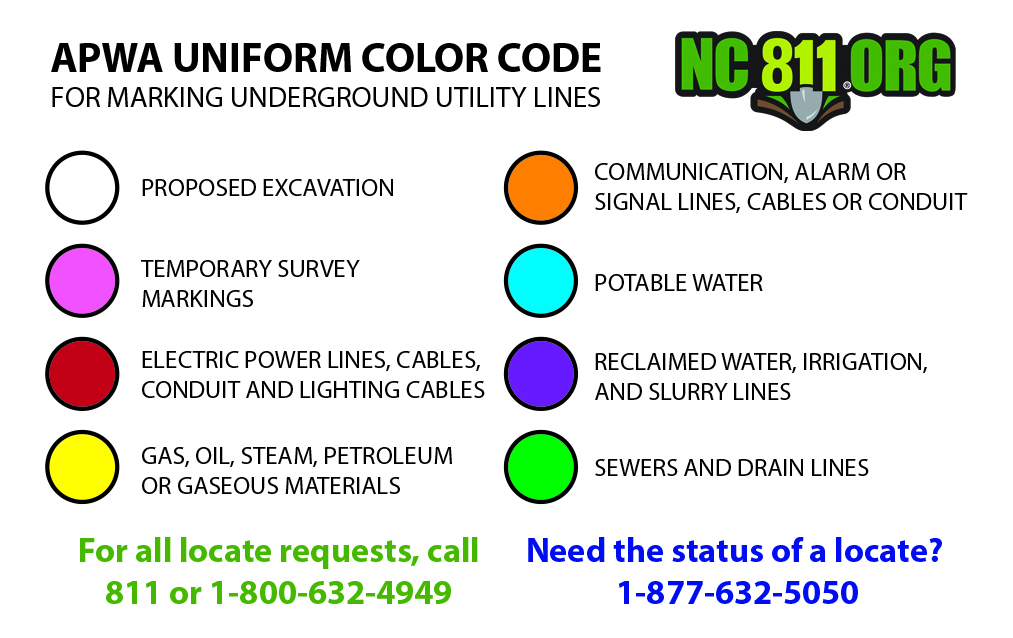
Your property’s underground facilities will be marked with color-coded paint, stakes, or flags. It is crucial not to disturb these markers once the underground facilities have been located. It’s advisable to communicate to young children that the brightly colored flags are not toys and should not be removed. Utilize the color code chart as a reference to identify the marked underground facilities. The APWA uses a nationwide color-coding system for underground utility markings. White outlines the proposed excavation area, pink is used for temporary survey markings, red identifies electrical facilities, yellow marks gas and petroleum lines, orange indicates communication systems, blue designates potable water lines, green marks sewer and drainage systems, and purple identifies reclaimed water infrastructure.
STEP FIVE: Dig with care
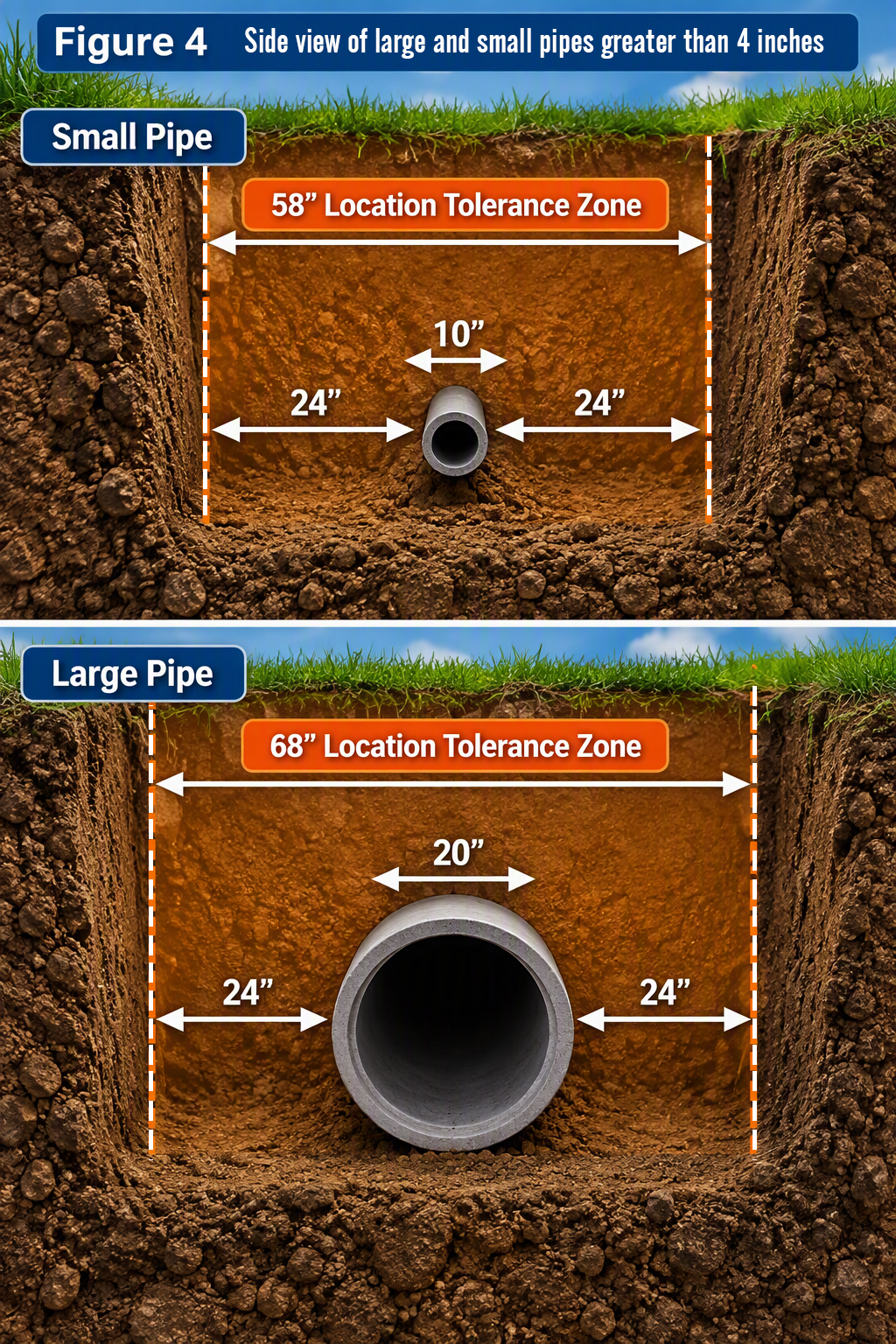
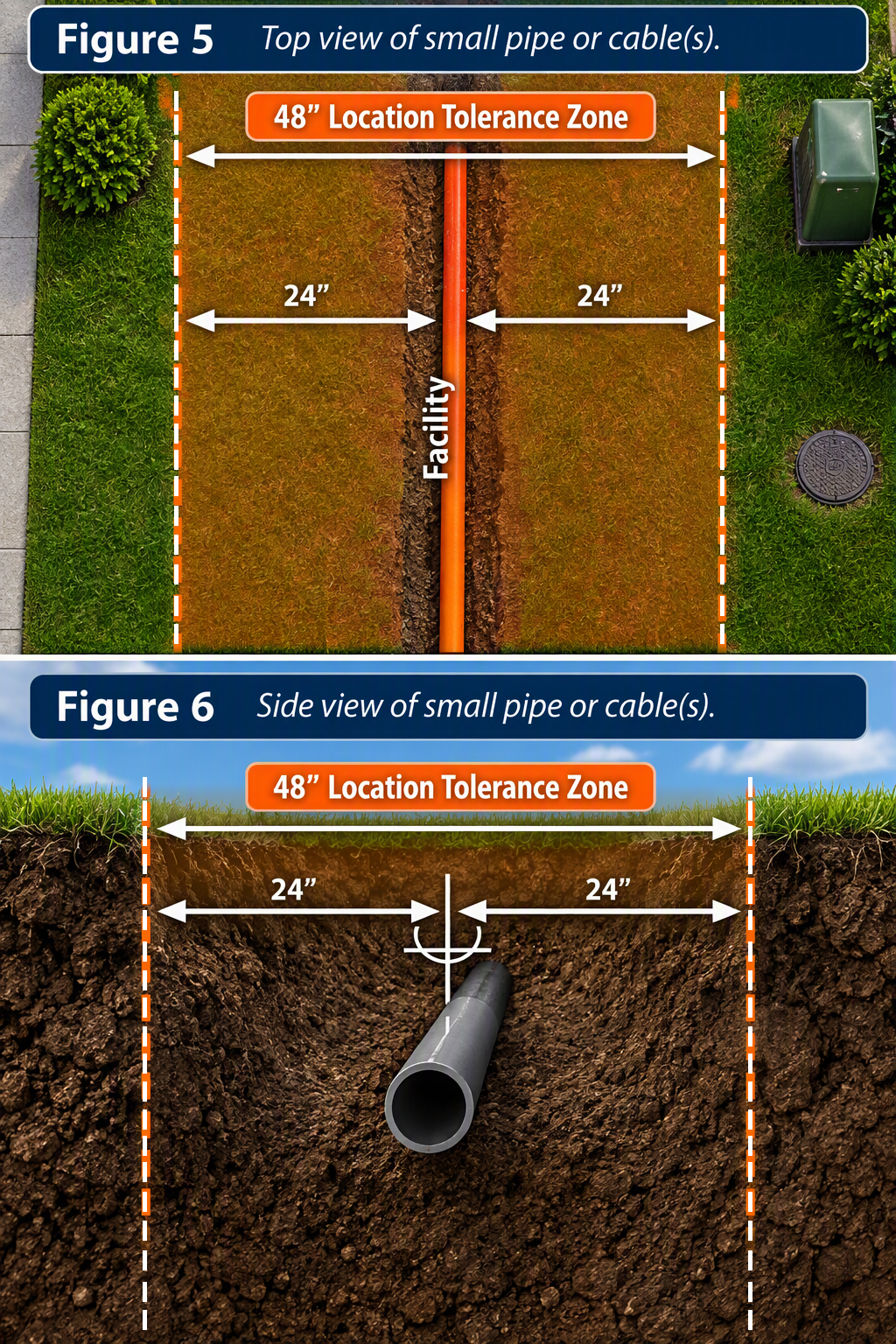
The location tolerance zone width encompasses 24 inches horizontally on each side of the utility, in addition to the utility’s width. When excavation is required within the marked tolerance zone, the excavator shall not use mechanized equipment until the underground utility has been safely exposed and its location verified. Hand digging or other approved non-mechanical methods must be used to protect the utility from damage. NC811 does not possess information about the depth of the facilities. Facility owners follow their industry’s code when burying lines; nevertheless, variations in facility depths may arise due to installation practices, alterations in grade, soil erosion, and other factors that evolve over time.
In case of damage, it is essential to inform the facility owner directly, and you can call 811 to file a report of damage to underground facilities. If a gas product release occurs, promptly and safely relocate upwind and dial 911 to report the incident.
Become a Safe Digging Partner. A Safe Digging partner is a company who follows the law, keeps their employees educated and safe, and partners to share the message of safe digging. visit: nc811.org/811-initiatives/safe-digging-partner.html
Contact the NC811 Public Awareness & Outreach Department. Our Damage Prevention Liaisons at NC811 have information about attending your local Utility Coordinating Committee and Safety Meetings, and can provide onsite training and free educational tools. Visit: https://nc811.org/education/education-resources.html
Visually survey the area for indications of unmarked facilities which could include, but are not limited to: a pole, marker, pedestal, meter, or valve, and any other visible indications of a facility. If there are indications of unmarked facilities, contact NC811 for further processing.
Respect and preserve the markings placed by each facility to indicate the location of their underground utilities.
Excavate with caution. When working near a utility’s tolerance zone, use non-mechanized equipment such as hand tools or vacuum excavation methods to carefully expose the utilities. When crossing underground utilities within the tolerance zone it is recommended that the excavation be performed with hand tools or vacuum excavating equipment until the marked facility is visually identified.
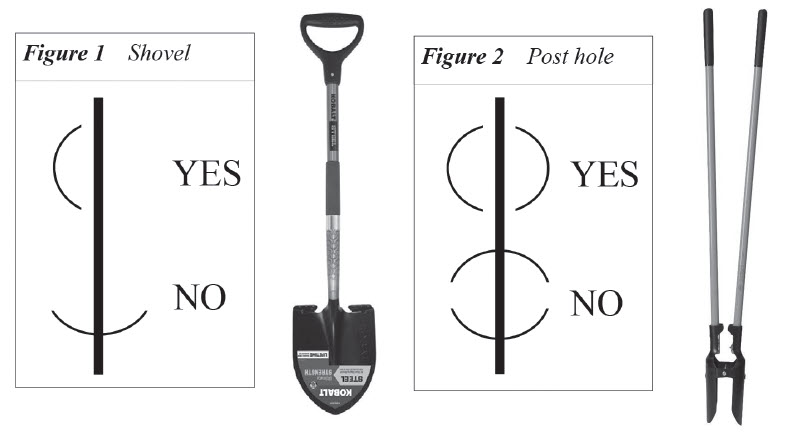
Avoid the use of picks and mattocks.
When using a shovel, keep the face of the blade toward the side of the facility. (See Figure 1).
When using post hole diggers, keep the opening between the blades going the same direction as the facility is running. (See Figure 2).
Beware of the possibility of abandoned facilities. Find, expose, and protect all facilities within the tolerance zone. Do not damage abandoned facilities as they may be reused by the facility at a later date. Be sure to treat all facilities as if they are an active facility.
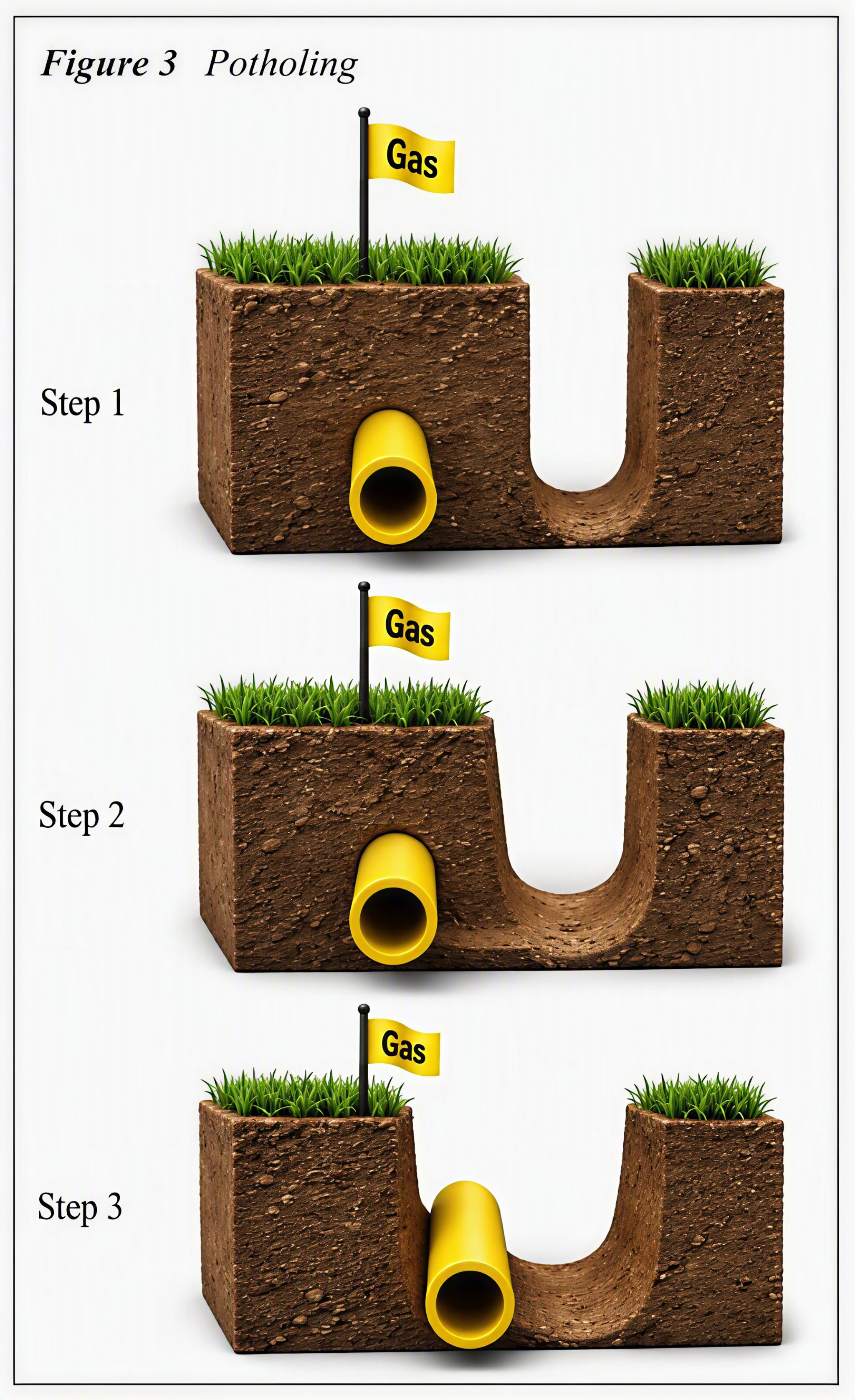
Pothole when paralleling underground facilities or digging in hard, compacted soils: At intervals, find and expose by hand digging, all facilities in the area to be disturbed by the excavation and adjust the path of excavation accordingly, if possible. (See Figure 3)
Note: The depths of underground facilities are not guaranteed. Excavators are responsible for finding and avoiding all facilities down to the depth of excavation.
Sensory Warning Signs
Smell: Natural gas has no natural odor, but utility companies add a chemical called mercaptan to give it a strong sulfur or “rotten egg” smell, making leaks easier to detect.
Sound: Listen for unusual hissing, whistling, or roaring noises coming from gas lines, meters, or gas-powered appliances.
Visual Indicators: Watch for a white mist, fog, or vapor cloud near a gas line. Other signs include blowing dust or bubbles forming in standing water.
Damaged Vegetation: Dead or discolored grass, shrubs, or plants—especially in an otherwise healthy area—may indicate a leaking underground gas line.
Gas Meter Activity: If your gas meter dial continues to spin rapidly even when all gas appliances and pilot lights are turned off, it could signal a leak.
Physical Symptoms
A gas leak can reduce the amount of oxygen in your home,
causing symptoms in both people and pets.
Mild to Moderate Symptoms: Headaches, dizziness, fatigue, nausea, and irritation of the eyes or throat.
Serious Symptoms: Chest pain, difficulty breathing, confusion, or loss of consciousness.
Pets: Signs may include lethargy, disorientation, or vomiting.
If you suspect a gas leak or a gas line is damaged, treat the situation as an emergency. Immediately evacuate the area and move everyone to a safe distance. Leave buildings right away and, if possible, leave doors open as you exit. Once safely away and upwind from the area, call 911 and notify the gas utility or facility operator. Do not attempt to repair, cover, conceal, locate, or stop the leak yourself. Allow any escaping gas to dissipate naturally into the atmosphere and keep people away from the affected area until emergency responders or gas company personnel arrive.
To prevent ignition, avoid creating sparks or using any electrical devices, including light switches, phones, flashlights, garage door openers, or other equipment. Do not smoke or use open flames. Never attempt to operate pipeline valves, as this could increase the danger or cause additional damage. If a natural gas fire is present, do not try to extinguish it yourself. Remain clear of the area and do not return until the gas operator or emergency services have confirmed that it is safe to do so.
Taking quick action can help protect your family, pets, and property from the dangers associated with natural gas leaks.
Response to the Locate Request After receiving the notification, each facility operator or their representative will provide a Positive Response within 3 full working days prior to the legal start date as to the status of the locate. Underground facilities present within the work area will be marked or flagged in accordance with the American Public Works Association Uniform Color Code.
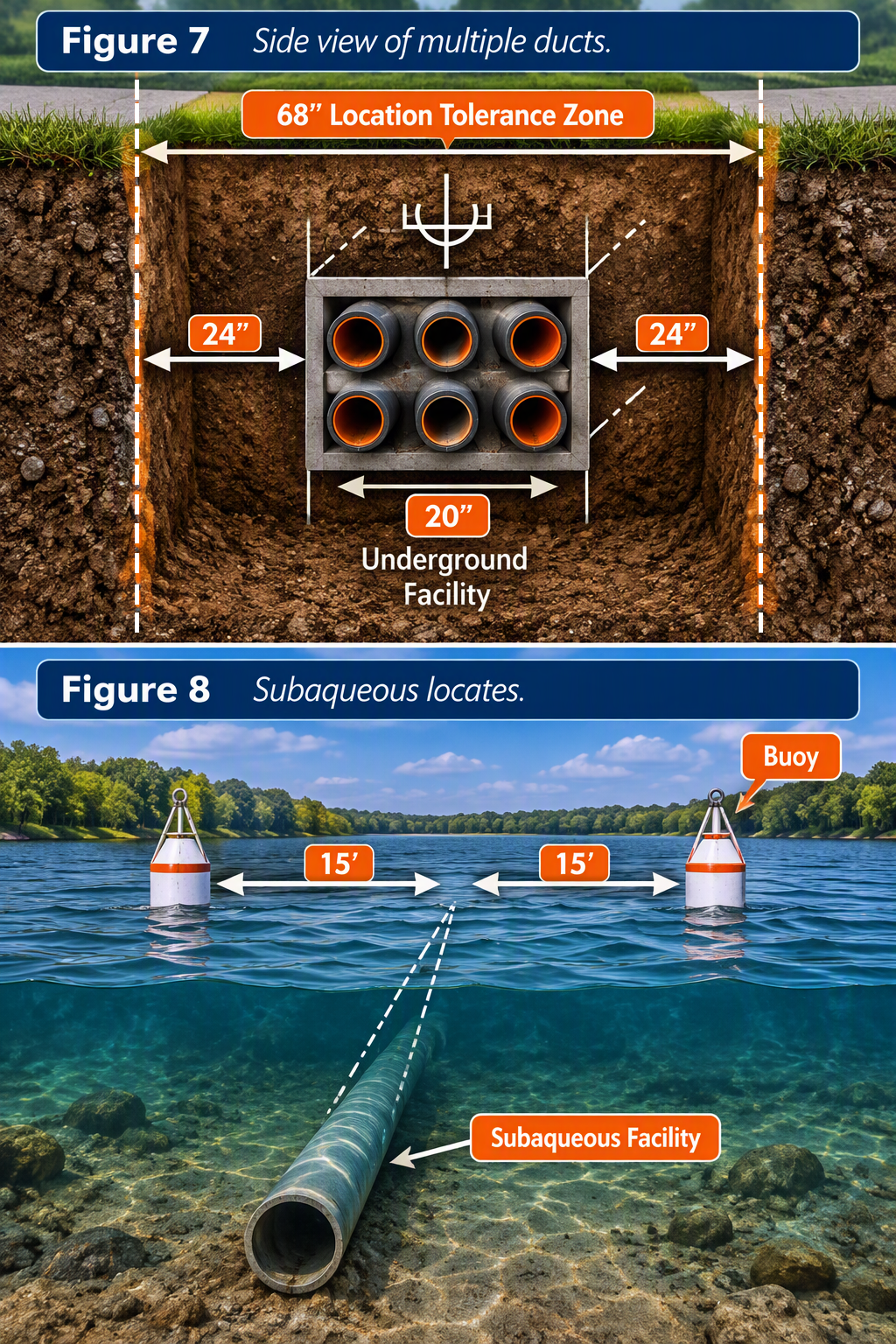
Facility Marking Guidelines The following illustrations (figures 4 - 8) show how various types of underground facilities should be marked. The width of the location tolerance zone includes the 24 inches on each side of the facility plus one half the diameter of the facility, if known. If an excavator must dig within the tolerance zone, digging with caution by hand or vacuum excavation is recommended to help reduce the possibility of damage to the located facility. Facilities greater than four inches in diameter/width shall be marked at least every 50 feet, 87-121(a)(1). For subaqueous facilities there is a clearance of 15 feet on either side of the indicated facility.
Ticket Guidelines
The following is a list of questions in the order that they will be asked by a Customer Service Representative when a normal notification is being made. Please be prepared to provide the information when speaking with a Customer Service Representative.
Excavator Information
The Underground Utility Safety and Damage Prevention Act requires the name, address and telephone number of the person providing the notice and, if different, the person responsible for the proposed excavation or demolition.
Email Address
Provide an email address to receive a copy of the notification. An additional Follow-Up Confirmation Email will be sent to the excavator at the Legal Start Date with the available responses.
County/Place
Provide the county and the city or town where the excavation or demolition will take place.
Subdivision/Business
If the location is in a subdivision or at a business, please provide the name. This will help the utility locators to more easily find the work site.
Worksite Access
The work site should be accessible in order to locate. Be prepared to provide gate codes, animals, etc. as this is helpful for the utility locator prior to arriving.
Address
To accurately identify the work location, provide the complete street address whenever possible. If a full address is not available, include the street name, road name, highway number, or secondary road number. Be sure that all street and road names are spelled exactly as they appear on maps and in the field to avoid confusion.
If additional directions are needed to locate the work site, make them clear, detailed, and specific. It is also helpful to include any information that may assist the utility locator, such as gate access codes, restricted entry instructions, or the presence of animals on the property.
The following is an example of good address information: 123 Oak Ln with a cross-street of Elm Tree Ct in Arbor Ridge subdivision.
Cross-Street Name
The name of the cross-street nearest to the jobsite address is needed, along with its distance from the work site, if known. A cross-street is the road that actually intersects with the street, or within a 1/4 mile from where the work is being done. It is not always a major road in the vicinity as some mistakenly believe.
Intersection
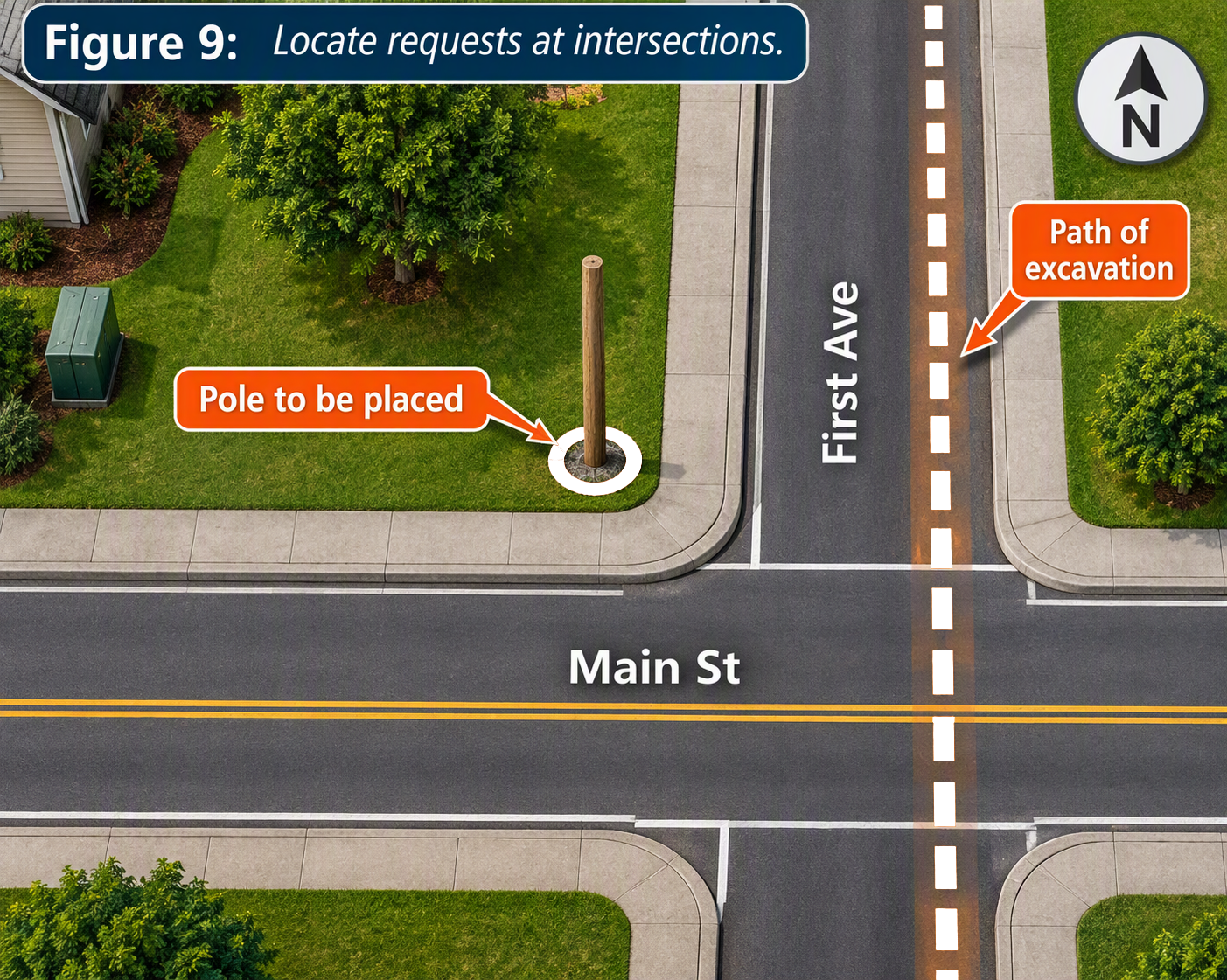
Intersection tickets will encompass just the area within the four corners of the intersections. When work continues on one or more streets from the intersection, a locate request will be created for each street. Distance per ticket to be limited to one of the following: The lesser of five adjoining parcels identified by addresses, not to exceed ¼ mile in linear length or an area not to exceed ¼ mile in linear length. If work is occurring along an alleyway, railroad, ramp or cross country and the total locate distance is less than 1/4 mile, then you can process just one ticket for the excavation site. If the work is taking place on a corner property up to the road frontage of the street, cross street and/or both, you may process this on one locate request. (see figure 9).
Scenario 1: If excavation will take place at the intersection with a bore under Main St. and along the east side of First Ave., the locate should state: Locate starting at the white flag on the South side of Main St and continue North for 800 feet along the East side of First Ave to the other white flag.
Scenario 2: If a pole is to be placed on a specific corner, the best way to describe the locate would be to state: Locate 10 foot radius around the white stake on the Northwest corner of Main St and First Ave.
Area to Locate The location of the proposed excavation or demolition is required by the Underground Utility Safety and Damage Prevention Act. It is best to describe the specific area where the excavation will take place; entire property or additional areas should not be included in the locate area unless they are absolutely needed.
Below are three examples of good locate area descriptions.
Locate entire front property.
Locate rear and both sides of building.
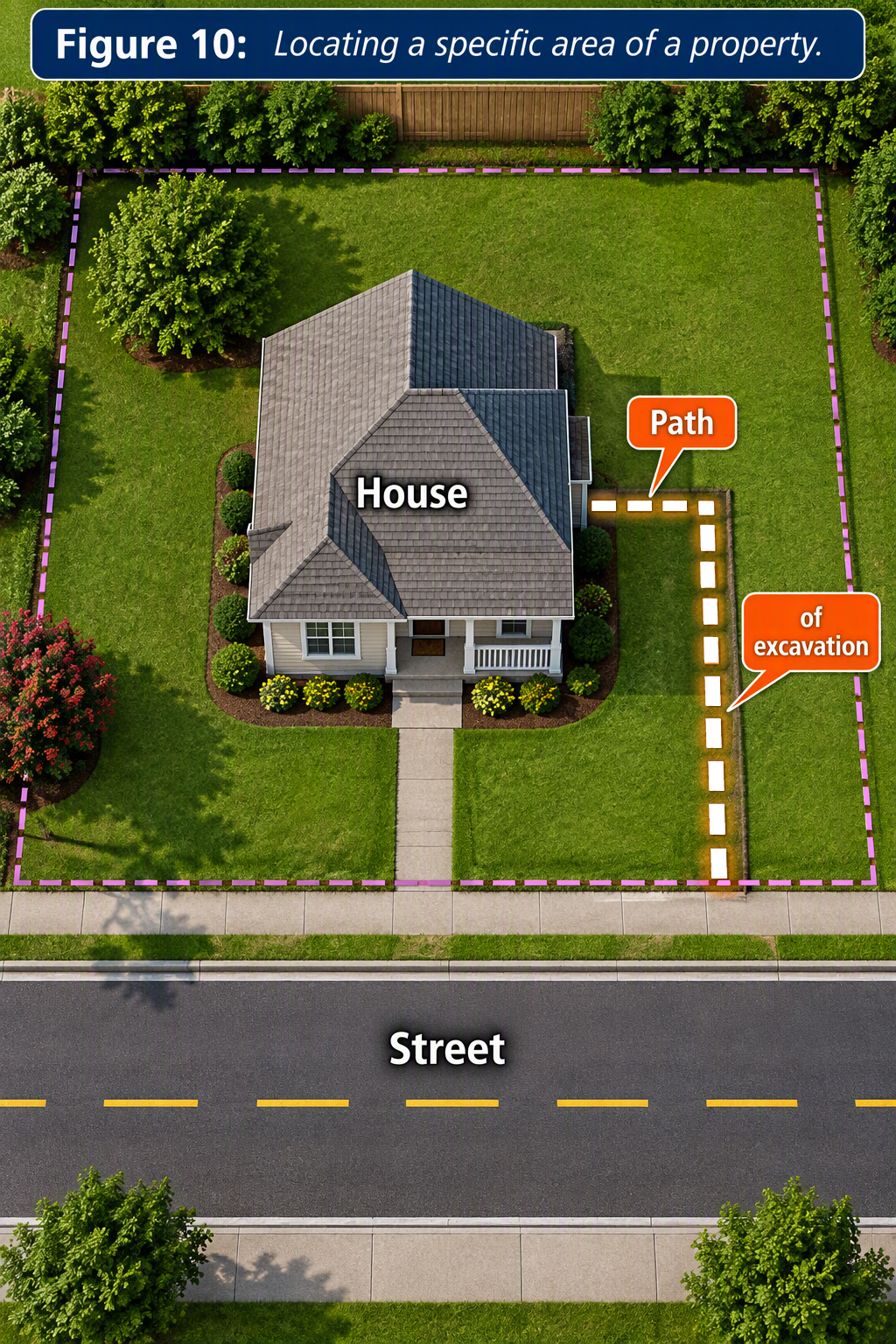
As facing, locate along right side of driveway from curb to house (See figure 10)
When excavation is not going to be taking place on all areas of a property, the specific area of the excavation should be requested. If a telephone drop were being placed to a house as indicated, the best way to describe the locate would be to state: As facing from street, locate the entire right side of property from the street to the back right corner of the house; area marked in white paint. (See figure 10)
Per the North Carolina Underground Utility Safety and Damage Prevention Act: § 87-122 (b) 5 (a) (b), Excavator responsibilities. The area of locate of the proposed excavation which is limited to an area the excavator reasonably believes may be completed within 28 calendar days from the work start date and does not include any areas completed and accepted by the authorities having jurisdiction. The area of locate is also limited to one of the following: A single parcel that may exceed ¼ mile in linear length identified by a single address. The lesser of five adjoining parcels identified by addresses, not to exceed ¼ mile in linear length or an area not to exceed ¼ mile in linear length.
White Lining When the excavation area cannot be clearly and adequately identified within the area described, then the location area must be pre-marked with soluble white paint, white flags or white stakes. per G.S. 87-122 (c)(1)
Blasting If explosives will be used during the excavation, this information must be provided as it is required by the Underground Utility Safety and Damage Prevention Act.
Boring This question is asked on all notifications regardless of the work type. Some member facility operators want to know if boring will be done as part of the excavation so that they can take extra precautions in protecting their underground facilities. If boring under a hard surface like a street, sidewalk, parking area, etc., the entering and exiting sides of the bore, plus the area between them, should be requested to be located.
Railroad This question is asked on all notifications because some member facility operators have fiber optic cables buried on railroad right-of-ways. These fiber optic cables are vital for data transmission and communications. Therefore, owners of these facilities want to know when any type of excavation is taking place near a railroad.
Work Date & Time This is the anticipated date and time that the excavation or demolition will begin. It is very important not to begin work prior to the legal start date and time. The legal start date is no less than 3 full working days before the proposed commencement date of the excavation or demolition. “Working Day” means every day except every day, except Saturday, Sunday, or State legal holidays..
Not every locate scenario can be described in this manual; however, a Customer Service Representative may be able to help explain what information the excavator needs to provide.
Emergency Locates In the event an emergency locate is needed, see “Emergency” under Types of Notifications.
Duration of Work The approximate number of hours, days, weeks, months or years that the excavation or demolition project will be taking place. This is required by the Underground Utility Safety and Damage Prevention Act.
Work Type The Underground Utility Safety and Damage Prevention Act requires this information to accurately identify the type of work, demolition, or excavation being performed. Member facility operators rely on these details to determine whether their underground facilities may be affected by the proposed work.
Please provide a clear and specific description of the excavation activity. General terms such as “digging” or “excavating” do not provide enough information. Instead, describe the actual work being performed, as shown in the examples below.
Installing gas service
Planting trees
Putting up a fence
Setting a pole
Installing fiber conduit
Work Done For This is the name of the person or company for which the work is being performed.
Excavators must give notice no less than 3 full working days before starting work. For underwater facilities, the notice period is no less than 10 to 20 working days.
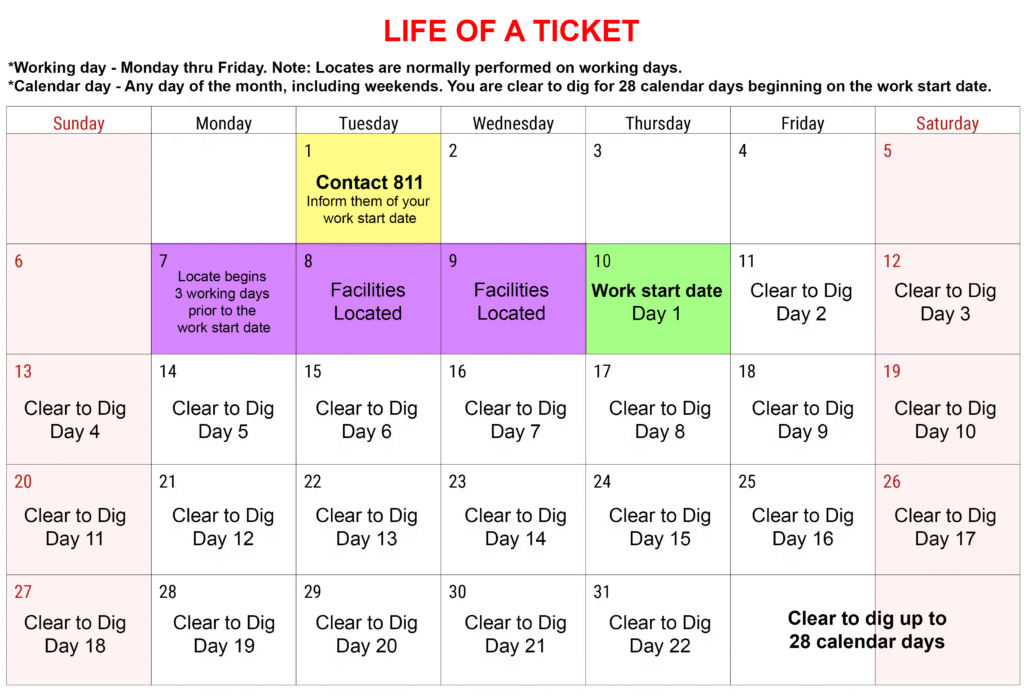
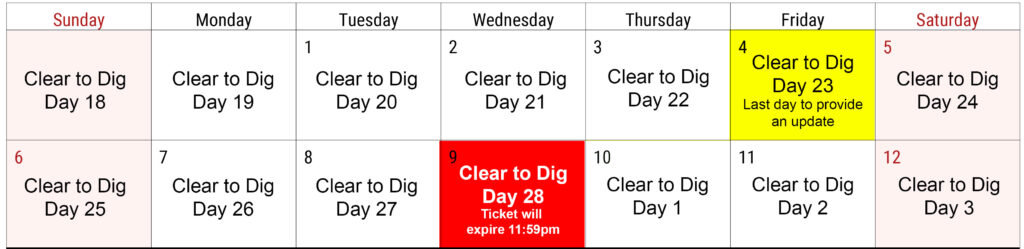
Below in this example the excavator contacted 811 on the 1st. During the call or while creating the CENTER LOGiX or SAT ticket the work start date is noted on the ticket. Three full working days prior to the work start date, locators will be dispatched to mark your excavation area. The life of the ticket begins on the Legal start date and you are clear to dig for up to 28 calendar days.
LIFE OF A TICKET *Working Day - Monday thru Friday. Note: Locates are normally performed on working days. *Valid 28 Calendar Days - Any day of the month, including weekends. You are clear to dig for 28 calendar days beginning on the work start date.
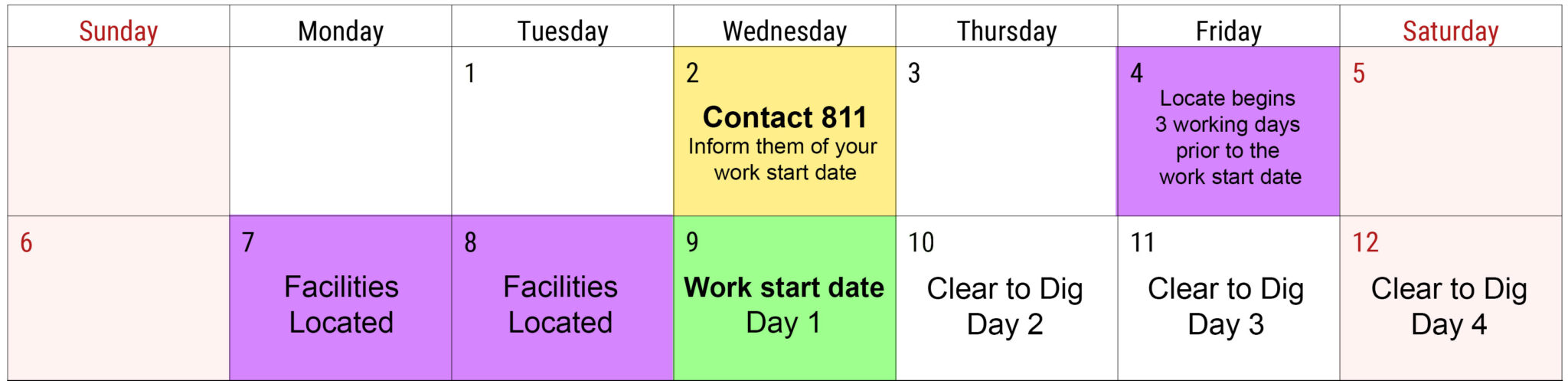
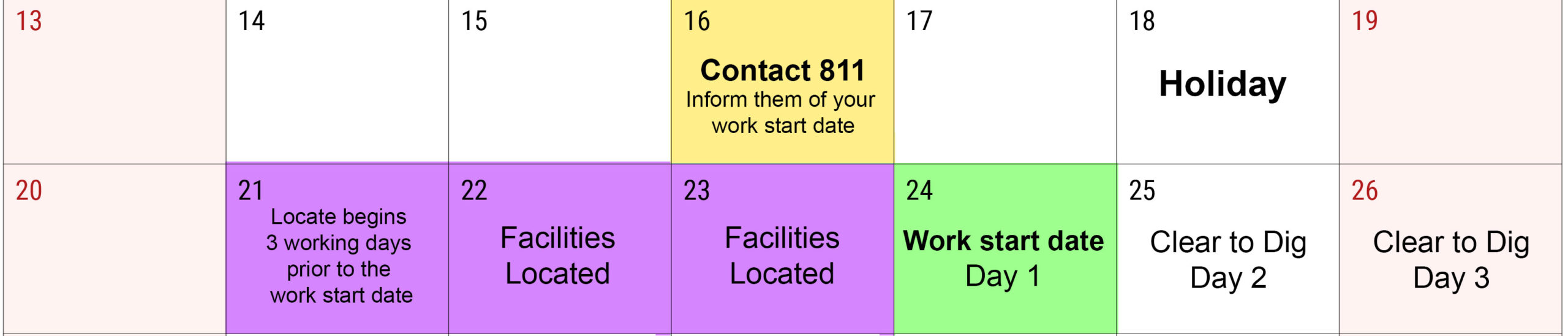
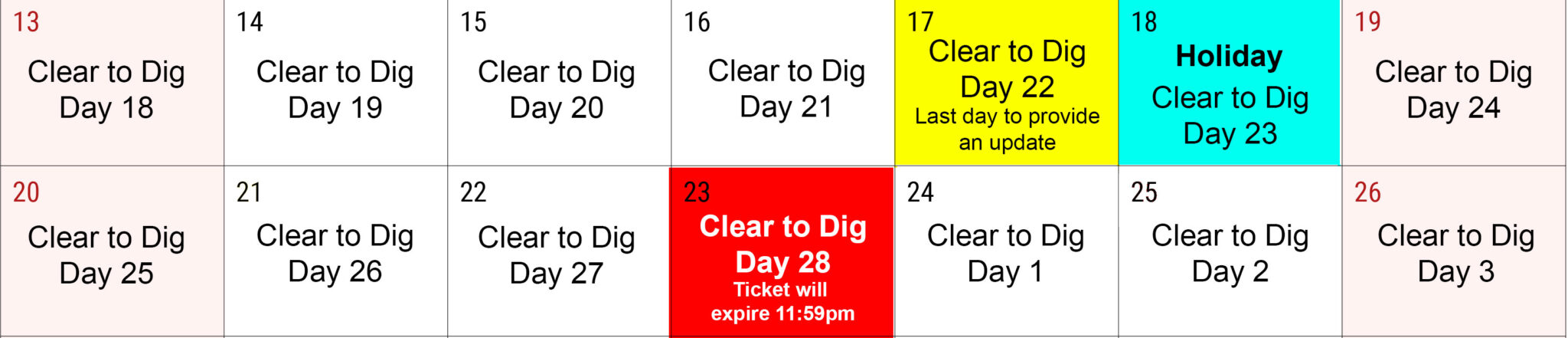
Weekends and Holiday can affect the locate process. Here are some examples. In graph 1 you see when the locate would be performed if the start date lands on a Wednesday. The locate would begin on Friday and continue thru Tuesday. In graph 2 you see what would happen if a holiday landed on a Friday during the locate process.
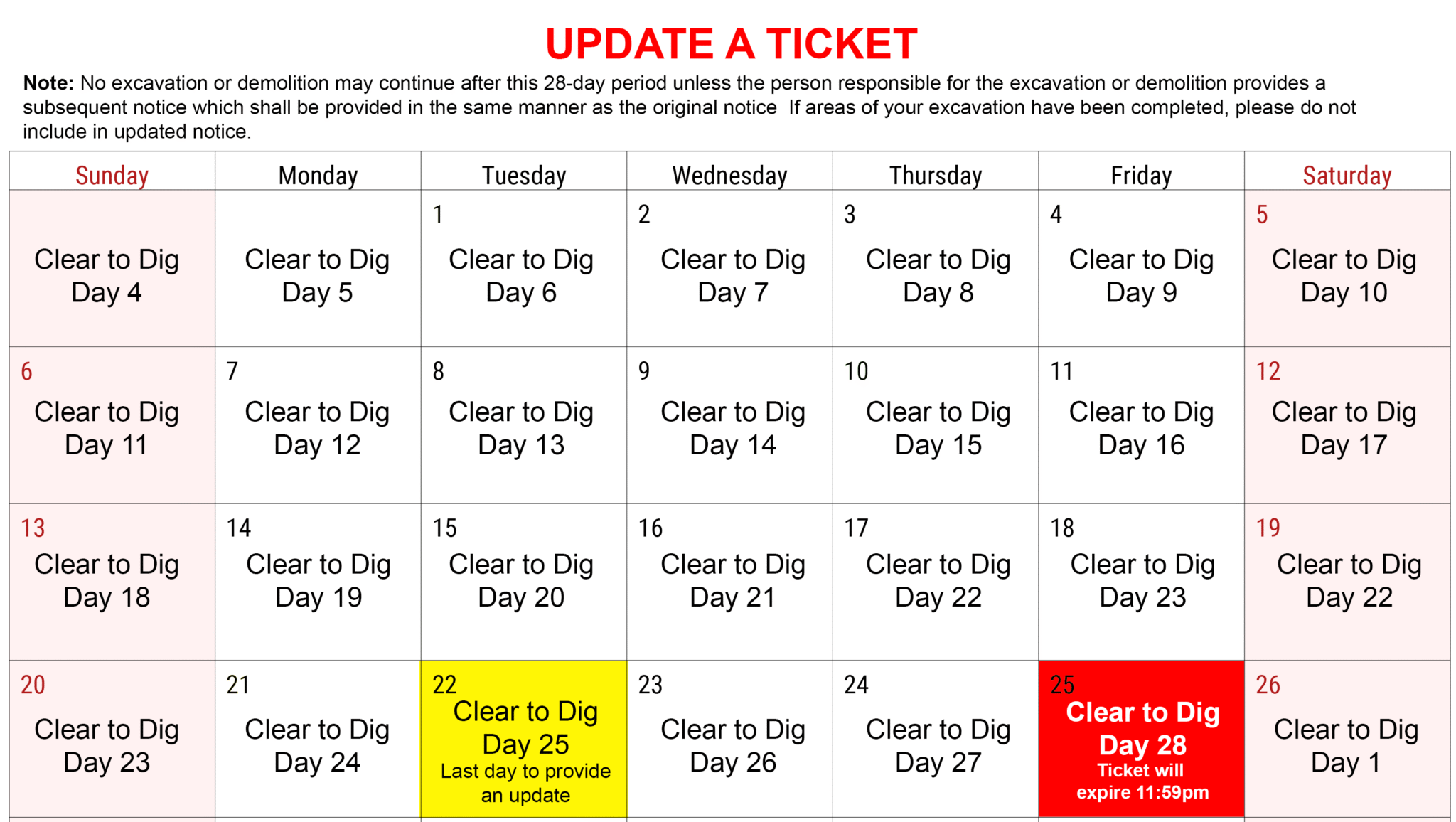
Graph 1 Graph 2 In order to extend the life of your ticket past the 28 calendar days you will need to submit a subsequent notice 3 full working days prior to the expiration date of your locate request. You need to provide your update no later than day 25 of your ticket. Locators then have day 26, 27 and 28 to update the locate request. After 11:59pm on day 28, your ticket will begin again, giving you another 28 calendar days for excavation to take place.
UPDATE A TICKET Note: No excavation or demolition may continue after the 28-day period unless the person responsible for the excavation or demolition provides a subsequent notice which shall be provided in the manner as the original notice.
Weekends and Holiday can affect the update process too. Here are some examples. In Graph 1 we see that the 28th day of the ticket lands on a Wednesday. Since the update must be made on a working day, the ticket is updated on the 23rd day of the ticket, giving the locators 3 full working days to respond to the update, the 26th, 27th and 28th days of the ticket. In Graph 2 a holiday lands on a Friday so the update must now be made no later than the 22nd day of the ticket.
Graph 1 Graph 2
As outlined on the preceding pages, the facing page has a form containing the list of basic information needed by NC811 when a locate is requested. Use it as a guide when calling in locates or make copies of it for filling in before a call.
Company Telephone Number
Caller Type
Company Name & Address
Caller Name
Company Name
Email Address
County
Place (City)
Work Site Access
Subdivision
Lot
Address / Street Name
Cross-Street Name 1 (nearest intersecting street)
Cross-Street Name 2 (nearest intersecting street)
Location / Stake info to locate
Blasting Y / N
Boring Y / N
Railroad Y / N
White Lining Y / N
Duration of Work
Work Type
Work done for
Site Contact
Site Contact Phone
Subcontractor
Subcontractor Phone
Work Date / Work Time
Emergency Y / N
Remarks (Additional Comments)
Utilities Notified
Ticket Number / Locate Due
Good Thru / Update
Normal A normal ticket is requested when any excavation and/or demolition is planned. This is the standard type of ticket used and requires a 3 full working day notice.
Retransmit Until a ticket expires it may be resent to one or more of the members originally notified. The excavator may request to notify additional members, add more directions or contact numbers. Should a new facility member be added, they have 3 full working days to respond.
Update In the event the excavation and/or demolition activities continue beyond the 28 calendar days (life of the notice), the excavator will need to update the notice per NC General Statutes. Updates can be requested no later than 3 working days prior to the expiration of the ticket. Changes cannot be made to an update notification. Should changes occur, a new notice will need to be processed.
Emergency Emergency excavation or demolition notifications from excavators are accepted 24 hours a day, 7 days a week and are transmitted immediately to the member operator. NC General Statues 87-117 (8) define emergency as “an event involving a clear and imminent danger to life, health, or property, the interruption of essential utility services, or the blockage of transportation facilities, including highways, railways, waterways, or airways that require immediate action.”
An excavator performing an emergency excavation or demolition is not required to give notice to the Notification Center as provided in G.S. 87-122. However, the excavator shall, as soon as practicable, give notice to the Notification Center which shall include a description of the circumstances justifying the emergency, per 87-125 (a)
Excavators falsely claiming an emergency exists may be subject to a complaint being made to the Underground Damage Prevention Review Board. False claims shall be punishable as a Class 3 misdemeanor to include other penalties and/or action taken by that board per the G.S. 87-125 (c). North Carolina 811 does not determine what is or is not an emergency notification. For an emergency request, an initial contact with the excavator shall be made within three hours by the Facility Operator. 87-121 (b) (4).
Report of Damage The Underground Utility Safety and Damage Prevention Act requires that any excavator performing an excavation or demolition that results in any damage to a facility shall immediately upon discovery of the damage notify North Carolina 811 and the facility operator, if known, and provide the location and nature of the damage per G.S. 87-126 (a). NC811 will create a Report of Damage ticket and send it to any affected utility immediately. A Report of Damage is not a locate ticket and cannot be used to get lines located. Also, a Report of Damage does not relieve the excavator from any responsibility regarding the damages. Contact 911 immediately and the facility owner if the damage has resulted in the discharge or electricity, the escape of any flammable, toxic, or corrosive gas or liquid, or endangers life, health, or property in accordance with G.S. 87-126 (b).
Destroyed Marks In the event the locate markings have been destroyed, the excavator may request a Destroyed Marks notice as long as the original notice is active and has yet to expire. This notice is resent to all or specific members to request a remark of the area requested on the original notice. As a reminder, the individual is responsible for preserving the markings once the area has been marked. Markings can be destroyed due to weather, grading, heavy traffic, etc. A destroyed marks ticket does not extend the life of a ticket.
Design/Survey A design or survey ticket is requested for those responsible for designing underground facilities or those who require a general description and location of existing underground facilities in an area. Since there will be no digging and, therefore, no risk to the underground utilities; the member utilities or their contract locators have 10 full working days to respond to a design/survey ticket instead of the usual 3 full working days.
Three Hour If a facility operator does not provide a locate status through the NC811 Positive Response System, the excavator may proceed with excavation or demolition only if there are no visible indications of a facility in the proposed work area, such as a pole, marker, pedestal, meter, or valve.
If the excavator is aware of or observes indications of an unmarked facility, excavation or demolition shall not begin. The excavator shall submit an additional notice to NC811 identifying the facility, and arrangements must be made for the facility operator to mark the facility within three hours from the time NC811 receives the additional notice.
A three-hour notification can be entered anytime including after hours. Once the ticket is within the applicable three-full-working-day locate period and the requirements for a Three-Hour notification have been met, the notification may be entered at any time during the life of the ticket.
In the event a member provided a Positive Response but the excavator states there is a discrepancy, see examples listed below,
– Member posted a PR Code 10 — NO CONFLICT but excavator states facilities ARE present
– Member posted a PR Code 20 — MARKED but excavator states the requested area to be marked was not marked, not completely marked, improperly marked, and/or wrong address was marked
Who is required to notify North Carolina 811 when they are going to dig? Anyone who intends to excavate (disturb the earth’s surface) in North Carolina, unless specifically exempted in the Underground Utility Safety and Damage Prevention Act, 87-124.
If I am a sub-contractor do I need to get a separate locate request or will the general contractor’s ticket protect me? NC811 recommends that all excavators request their own locates. Even though a sub-contractor may be noted on a location request, the sub-contractor should request his or her own locate ticket to be certain of protection.
How do I know if all members have marked or cleared my site? Use the NC811 Positive Response System to confirm the status of your locate. See section on Positive Response for detailed instructions.
I’ve received a Positive Response update indicating that all facility owners have reported the site as located. However, when I arrived at the job site, some or all of the utility locate marks were missing. What should I do? Do not begin excavation. It is unsafe to dig until you determine why the locate marks are not visible. There are several possible reasons for missing marks, including:
The wrong area may have been marked.
Weather conditions may have faded, washed away, or otherwise obscured the markings.
The site may have been vandalized or disturbed.
In some cases, facility owners may have screened the ticket and
provided an inaccurate or incomplete response.
Never assume a site has been properly marked simply because a Positive Response has been provided. If the marks are not visible, stop work and make an additional call to 811 requesting a three-hour notice.
Why don’t the utility locators indicate the depth of facilities? The North Carolina Underground Utility Safety and Damage Prevention Act does not require that the depth be given. Facility depths can vary due to installation practices, changes in grade, soil erosion and other variables that occur over time.
When can I remove the flags or other physical markings on my property? Flags and other physical markings are good for 28 calendar days and should not be moved or removed before that time unless all excavation work is completed and not expected to resume.
I do not think the locate marks for underground facilities at my excavation site are correct. What should I do? If utility markings are believed to be incorrect, contact NC811 to request a three-hour notice and request that the locate ticket be sent back to the affected utility owners for remarking.
I’ve waited the required time and there are still no marks. What do I do? Members are required by law to respond to your locate request within 3 full working days. Check the NC811 Positive Response System to see if your site is clear of underground utilities. If the responses do not indicate such for all utilities, contact NC811 to request a three hour notice from the facility owner.
Who is liable if I damage an underground facility after choosing to excavate after the required time, but before all locates were done? Liability issues are between the utility owner and the excavator; NC811 cannot advise on such matters. For more information concerning the absence of facility location refer to G.S. 87-128.
What happens if I don’t provide a full three-working-day notice? North Carolina law requires excavators to provide at least three full working days’ notice before beginning excavation. If less than the required notice is given and excavation starts before all underground utilities have been properly located and marked, there is an increased risk of damaging underground facilities and causing injuries. In such cases, the excavator may be held responsible for any resulting damages as G.S 87-122 (a) requires no less than three full working days before the proposed commencement date of the excavation or demolition.
Why didn’t anyone show up for the requested meet at my excavation site? If you requested a meeting with utility locators at your excavation site and no one arrived at the scheduled time, it is likely because meet requests cannot always be accommodated. While NC811 is happy to add a meet request to any locate ticket and many locators make every effort to honor those requests, attendance is not guaranteed. To ensure a locator can meet onsite, excavators should contact the facility operator directly to confirm the request and coordinate the meeting.
There are underground facilities on my property, but they were not located. Why? Underground facilities may not be marked for several reasons. The NC811 Positive Response System can provide details on the status of your locate request and whether additional information is needed. If the requested work area is small and no utility lines are present within that area, a “no conflict” response may be issued. Additionally, utility companies typically locate only the lines they own. Private lines—such as those installed by homeowners or businesses to serve structures, equipment, or utility devices—are generally not marked. Water and sewer providers usually locate main lines and service lines to the meter, but not private water lines beyond the meter or sewer laterals. Private utility lines can be located by a contract locator; a list of providers is available at https://nc811.org/education/private-lines.html.
What is a private line? Primary power, gas and telecommunication lines will be marked by the utilities that manage them. Secondary water, sewer, gas and electric are considered private lines and will not be marked when contacting 811. Water, sewer, and storm drain lines are only marked within the right of way or to the meter, and not on private property. Lines from the right of way or meter to the residence or business are private lines and you will need to contact a private line locator to have these lines located. Also note, you must contact any non-member facility owners not listed on your location request directly to request their facilities to be located and marked.
Why wasn’t I connected to North Carolina 811 when I dialed 811 from my cell phone? If you are using a cell phone near a state border, dialing 811 may connect you to the one-call center in a neighboring state rather than North Carolina 811. This can happen when your call is routed through the nearest cell tower, which may be located across the state line. If this occurs, call 1-800-632-4949 directly to reach North Carolina 811 or use our online DiG LOGiX Single Address Ticket (SAT) to request your locate.https://diglogix.com/ticketaction
How do I know if I’m digging in a right-of-way or easement? Unfortunately, there is no definitive answer because these areas can be located anywhere. If it is not known whether a right-of-way or easement is on a jobsite, it is always best to contact NC811 to have any underground lines located so that they may be easier to avoid.
An easement is the right to use part of a property without owning it. Utility easements are one of the most common types of easements for private property, which generally allow public utility companies access to the property for the purpose of installing, repairing and maintaining utility lines.
The width of the easement can vary depending on the type of easement and what it is being use for. When you purchase a property the survey documentation should report any easements that come in direct contact with your land. It is important to be aware of these easements has they will have a bearing in where you can safely place structures such as sheds, fence lines and even trees.
There are two types of easements or right of ways
Permanent Easements. A “permanent easement” means the public entity is not purchasing your land outright but is buying the rights to alter it and use it for their own purposes. These types of easements include above ground and buried utilities, drainage, and slope easements. While you still own the property, you are no longer allowed to use it in any way that would interfere with the easements.
Temporary Easements. A “temporary easement” means the public entity is leasing a portion of your land for the length of time needed to complete a project. This is a temporary construction easement. You will get back full ownership of your land at the end of the project.
You only notify utilities that are members with NC811, how do I know what other utilities may be in my excavation area if they are not members? As of October 1, 2016 all operators of underground facilities in North Carolina are required by North Carolina’s Underground Utility Safety and Damage Prevention Act (the “Act”) to be a member of North Carolina 811, Inc. (the “Notification Center”). North Carolina 811, Inc. cannot guarantee that all operators of underground facilities in the state have complied with this membership requirement. North Carolina 811, Inc. will notify all operators of underground facilities that are members of North Carolina 811, Inc., as required by the Act. For more information refer to G.S. 87-122.
On what day can a locate be updated? A locate request needs to be updated no later than 3 workings day before the expiration of the ticket.
What is the required response time for an emergency request? For emergency requests, the facility operator must make initial contact with the excavator within three hours, as required by N.C. General Statute 87-121(b)(4).
NC811 cannot provide an exact time when facilities will be marked. However, after-hours emergency requests are transmitted immediately to the affected utility members, including an automated phone notification when requested by participating members.
Response times may vary among facility owners based on their after-hours procedures, staffing availability, and the travel time required for locators to reach the excavation site.
For additional requirements related to emergency excavation or demolition, refer to G.S. 87-125.
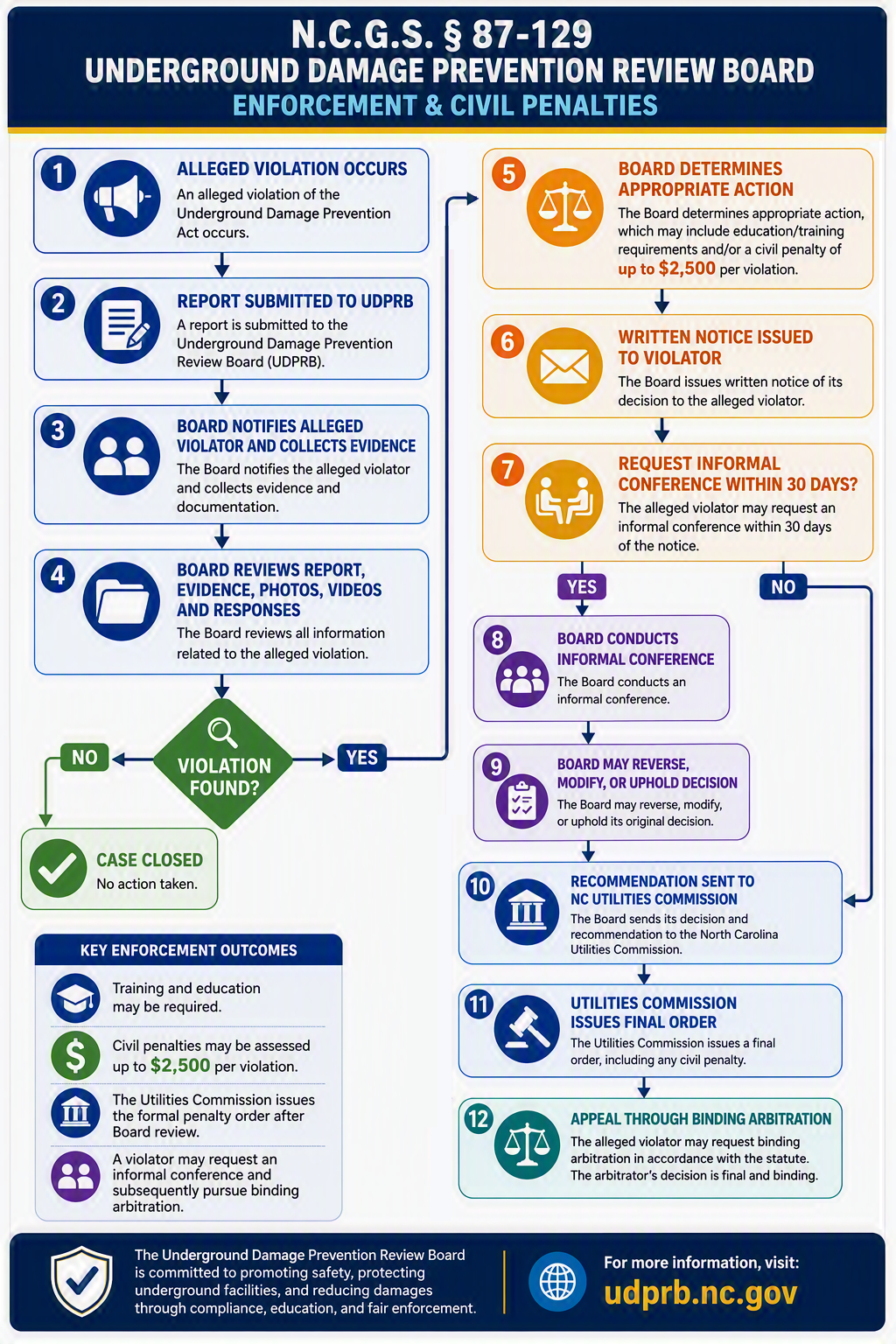
Purpose of the Board Establishes the Underground Damage Prevention Review Board to review alleged violations of North Carolina’s Underground Damage Prevention Act. The Board is responsible for investigating reports, determining violations, and recommending enforcement actions and penalties.
Board Composition Consists of 15 members appointed by the Governor
Complaint and Investigation Process
The Board receives and reviews reports of alleged violations.
The Board must notify the accused party of the allegation within 15 working days.
The Board maintains records and evidence submitted by:
The reporting party.
The party accused of the violation.
Records may include correspondence, photographs, videos, and other documentation.
Enforcement Authority
After reviewing a report, the Board may determine whether a violation occurred.
If a violation is found, the Board may impose or recommend:
Training or education requirements.
Civil penalties of up to $2,500 per violation.
The Board approves qualifying training courses and sponsors.
Violators are responsible for paying training costs.
Our Sponsors
A special thank you to all of our sponsors whose support helped make the NC811 Excavation Safety Manual possible. A PDF version is available for download, or you may request a printed copy from one of our Damage Prevention Liaisons. For printed copies or additional information, please contact Ann Rushing at annrushing@nc811.org.
Click on any of our sponsors below to visit their websites.
Thanks for your interest in joining our mailing list.
Sign up to stay in touch with NC811!
Please complete the information below and click Sign Up. We'll keep you up to date with everything happening at NC811 and when we have special promotions and giveaways, you'll be the first to know!